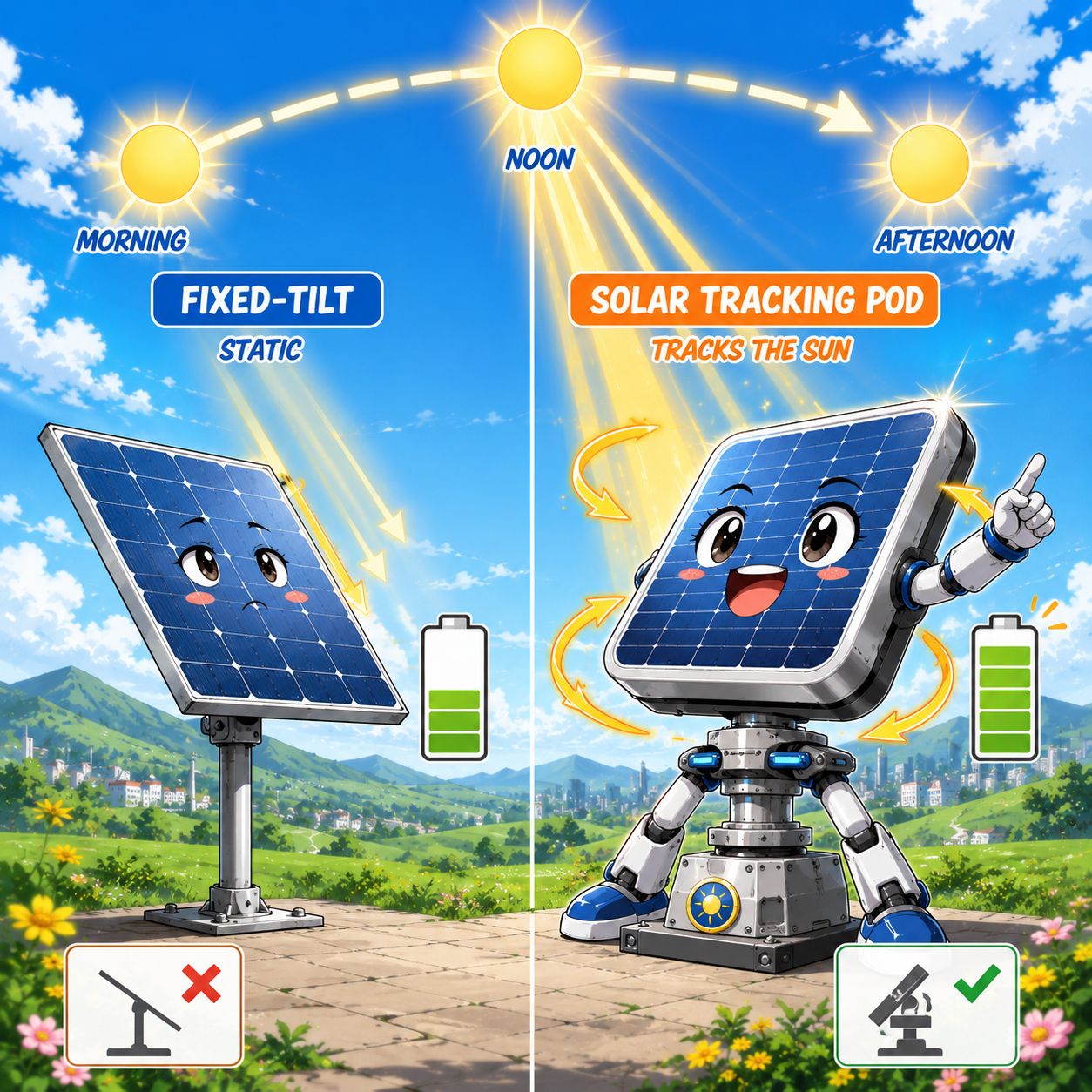
Morning
The array leans toward the early sun, trying to capture more production before a fixed panel reaches its strongest midday window.
A single-axis tracker moves in one main direction, usually to follow the sun from east to west. It is the practical middle ground between fixed solar simplicity and dual-axis complexity.

Single-axis tracking is not trying to do everything. It focuses on one useful movement and lets the production curve stretch across the day.
The array leans toward the early sun, trying to capture more production before a fixed panel reaches its strongest midday window.
The tracker moves through its central position while solar intensity is strong and the panel angle is less compromised.
The array turns toward the later sun, which can matter for batteries, EV charging, water pumping, and peak-rate timing.
In high wind or unsafe conditions, a tracker may need a controlled safe position instead of continuing to chase sunlight.
Single-axis tracking is usually about improving the shape of production over the day, not simply chasing a flashy number.
Single-axis tracking becomes interesting when the project has open space, a useful load profile, and enough value to justify moving parts.
The phrase “single-axis” sounds simple, but the real system includes torque tubes, bearings, drive hardware, controls, foundations, wiring movement, row spacing, wind behavior, and maintenance access.

A tracker presents different wind surfaces as it moves. Bad controls or weak structure can turn a good solar idea into a mechanical problem.
Fixed-Tilt Sensei is the quiet master of solar practicality. Single-axis tracking must earn its place.

A tracking pod should not move just because it can. It should move because the load, site, and economics make the motion useful.

Follow the related solar tracking topics and use cases.
Single-axis tracking is the practical tracker: one main movement, useful production-shaping potential, and less complexity than dual-axis. But fixed solar remains the standard unless tracking has a clear mission and professional design.